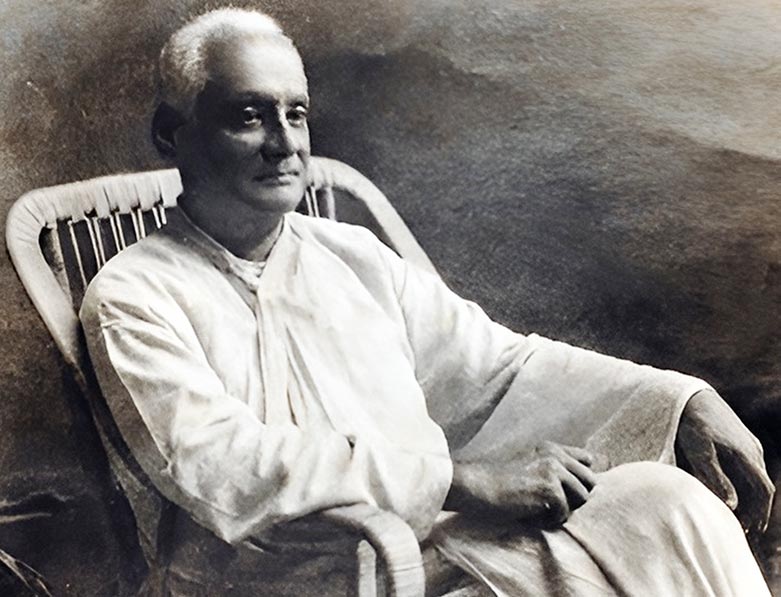
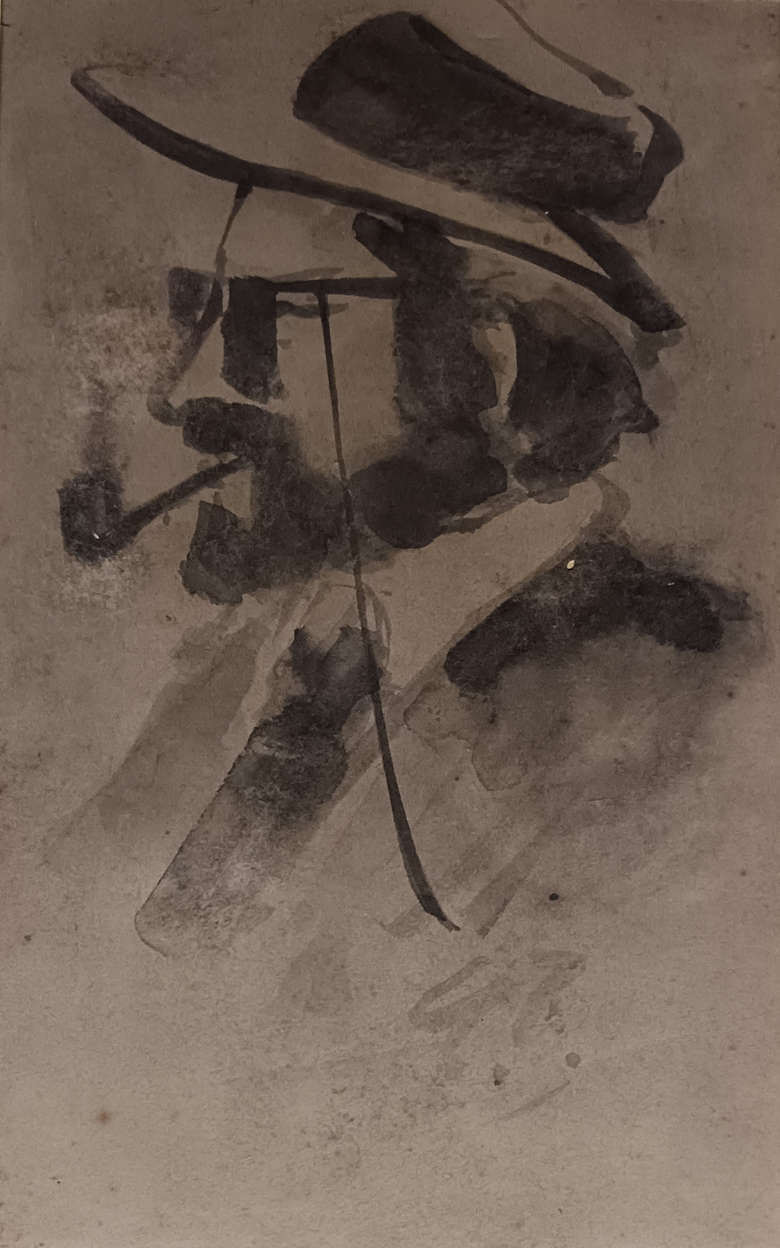
The true pioneer of cubism in India and acclaimed for his satirical works of art, Gaganendranath Tagore was born on 17 September 1867.
Gaganendranath Tagore (1867–1938), elder brother of Abanindranath and nephew of Rabindranath, was a pioneering modernist of the Bengal School. Though he began painting seriously in his late thirties, he quickly distinguished himself—first through Japanese-inspired brushwork and later with sharp caricatures that satirized colonial society. By the 1920s, he became the first Indian artist to fully embrace Cubism, creating bold geometric abstractions like City in the Night that fused Indian themes with international modernist vocabularies. As co-founder of the Indian Society of Oriental Art, he helped institutionalize modern art in Bengal. His legacy lies in bridging satire and abstraction, tradition and modernity, making him a crucial figure in the evolution of Indian modernism.
Along with his Nobel-laureate uncle Rabindranath Tagore, and brother Abanindranath Tagore, he was at the forefront of cultural revival in Bengal in the early twentieth century; the brothers established the Indian Society of Oriental Art, Calcutta, in 1907.
A self-taught artist, Tagore began painting late, at the age of thirty-eight. He learnt Japanese brushwork from visiting Japanese artists at Santiniketan. Initially, he painted Puri landscapes, portraits and other figurative sketches, scenes of Calcutta and illustrations for Rabindranath Tagore’s My Reminiscences, consisting of early known works Sibu Kirtania and Crows. In 1914, six of his paintings were sent to London, and then to the Pavilion Marson exhibition in Paris. Following this, cubism was introduced in his works. From 1917, he also published portfolios of cartoons, titled Birupa Bajra, Adbhut Lok, and Baba Hullod, which were merciless satires on contemporary Bengal society.
He was also the driving force behind the Vichitra club at the Tagore residence, even acquiring a lithographic press for it. He tried his hand—to enormous success—at each popular style of painting—watercolour landscapes, haunting night scenes, several Bengal School washes and Japanese brushwork.
His 1923 exhibition in Berlin and Hamburg received praise from German critics. He used form as a medium to communicate his feelings, and emphasised the structural quality in his works through semi-abstraction.
Tagore passed away on 14 February 1938.