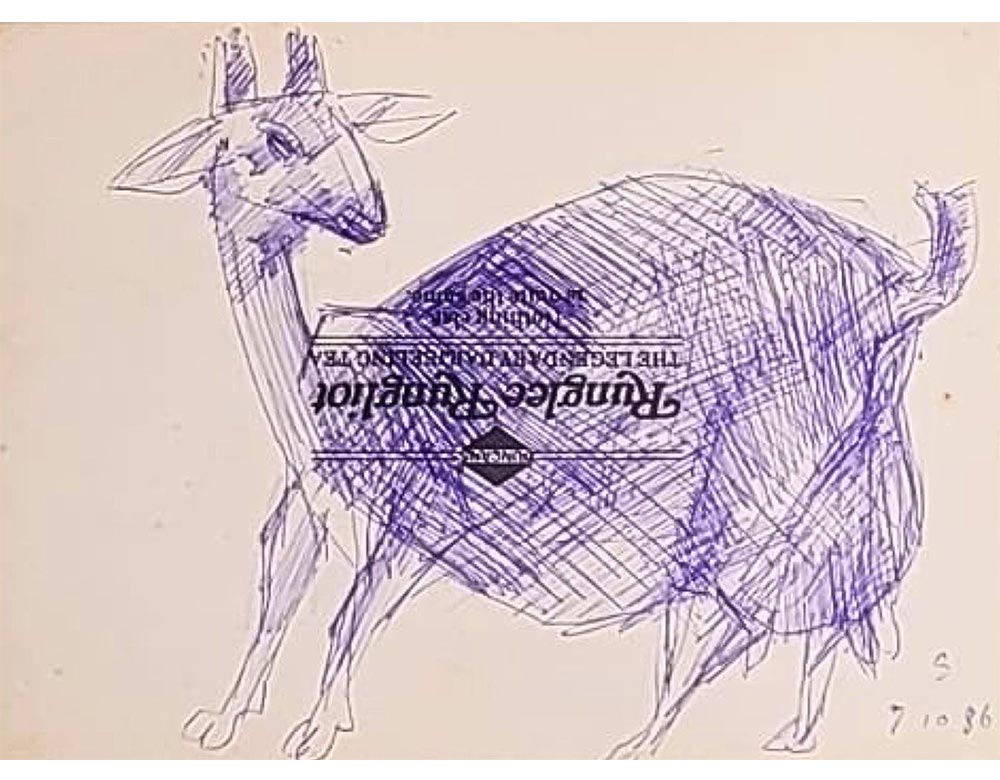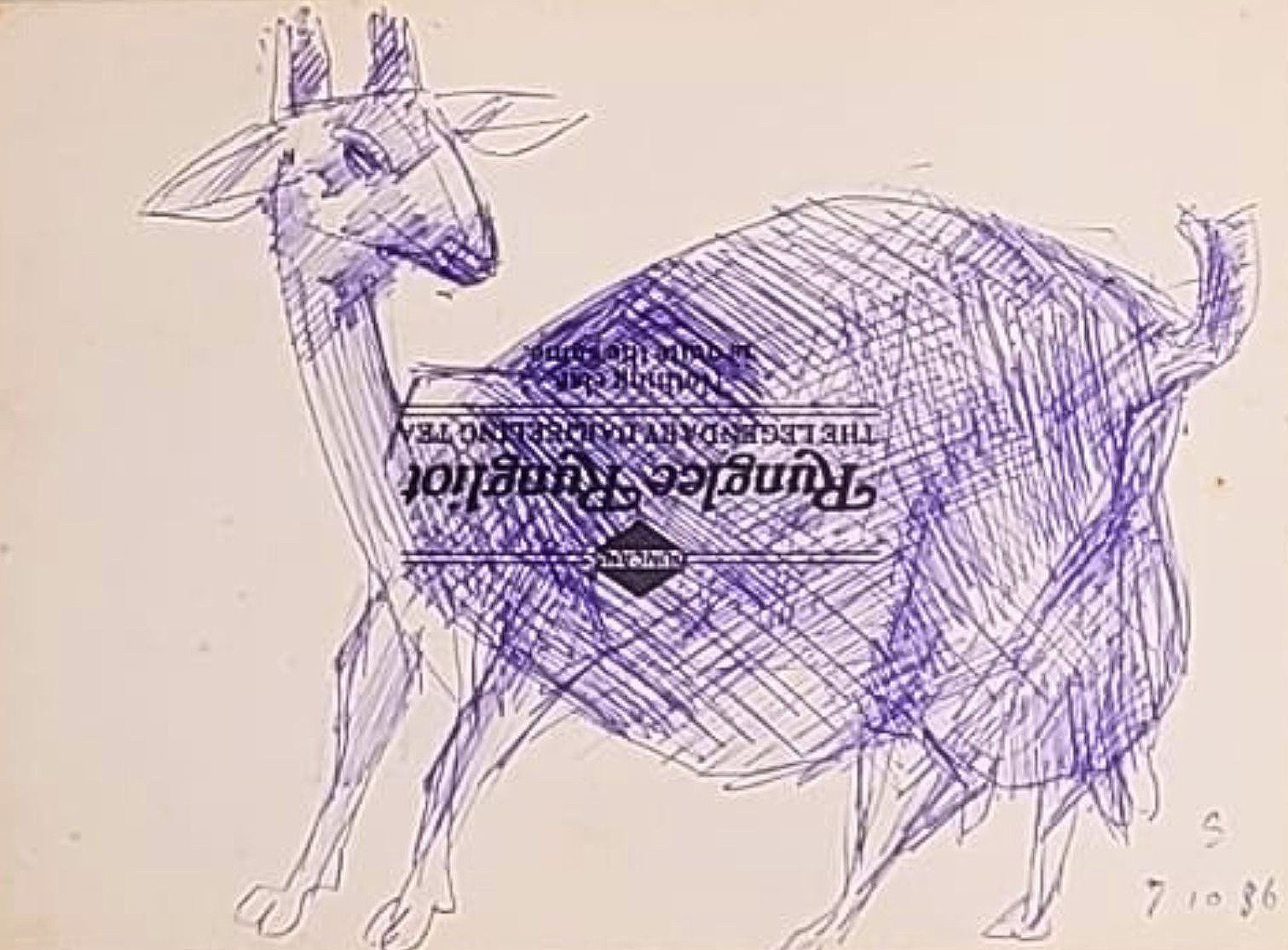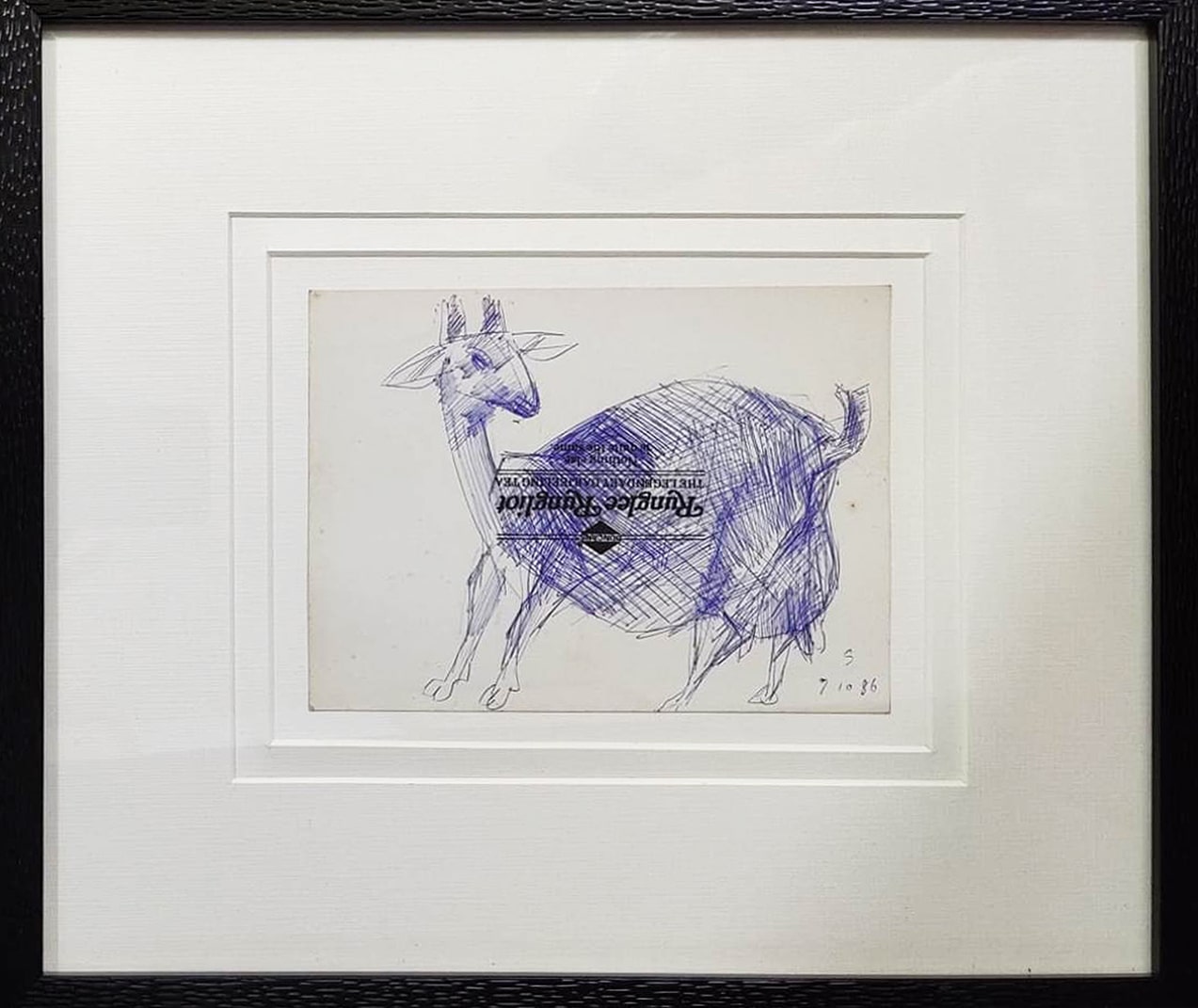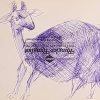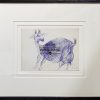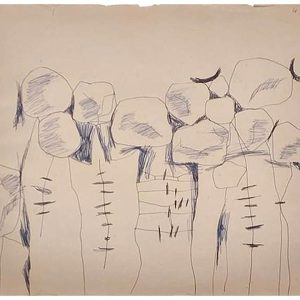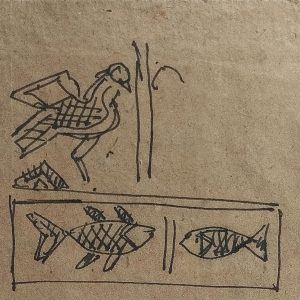
Somnath Hore | Untitled | Pen & Ink on Paper | 5 x 7 inches | 07-10-1986
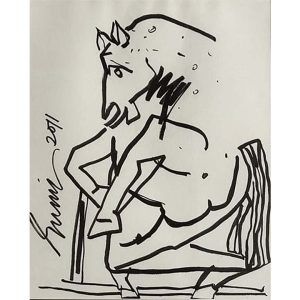
This pen and ink drawing by Somnath Hore, dated 07-10-1986, presents a lively sketch of a goat rendered with swift, confident lines and cross-hatching techniques. Using a simple blue ballpoint pen, Hore captures the form and character of the animal with minimal detail but remarkable immediacy. The goat’s large, rounded body contrasts with its delicate legs and expressive head, highlighting Hore’s skill in balancing form and rhythm. Intriguingly, the sketch appears to be done on the reverse side of a printed piece of paper—possibly a reused publication or pamphlet—hinting at the artist’s spontaneous and resourceful process. This unassuming drawing speaks to Hore’s deep engagement with everyday life and his ability to find expressive potential in the most modest materials.

Somnath hore was the quintessential bengal artist deeply affected by the cataclysms that changed its history, such as the 1943 famine. a man-made crisis resulting in the death of two-three million people and the 1946 tebhaga peasant uprising.
A multifaceted artist who spent a lifetime exploring human suffering through his sketches, prints and sculptures, Somnath Hore was born in Chittagong in present-day Bangladesh in 1921.
Studying briefly at Government School of Art, Calcutta, in the mid-1940s, Hore trained under Zainul Abedin, and, later, under printmaker Saifuddin Ahmed. A participatory practice with fellow artists like Chittaprosad led to his intellectual growth. Hore’s early sketches were published in Janayuddha and People’s War, publications of the Communist Party; like many young men in the 1940s, Hore too joined the political party though he drifted away from it later.
Hore chose a distinctly formal, Western style of artmaking, distinguished by its strong linear quality, and guided by humanist concerns that foregrounded the indigent grappling with issues of survival. Distilled into iconic heads and emaciated bodies, his act of recovering the erased re-inscribed them into public memory. The anguished human form was reflected in Hore’s figuration through bold, minimal strokes enhanced by rough surfaces, slits and holes.
Over a thirty-year teaching career, Hore set up the printmaking department of Delhi Polytechnic in 1958. He joined Kala Bhavana, Santiniketan, as head of its printmaking department in 1968, where his own practice received a boost under the guidance of Ramkinkar Baij and Benodebehari Mukherjee.

If you’d prefer the artwork to arrive ready to hang, please get in touch with us to arrange framing and shipping at applicable charges.
Please note: Customs duties and import taxes may apply at your destination in accordance with your country’s regulations. Refer to our International Shipment document for guidance and support.
| Dimensions | 17.78 × 12.7 cm |
|---|---|
| Medium | |
| Height | |
| Width | |
| Surface | |
| Style | Animal Drawing, Animals paintings, Figurative Drawings, Figurative Paintings |