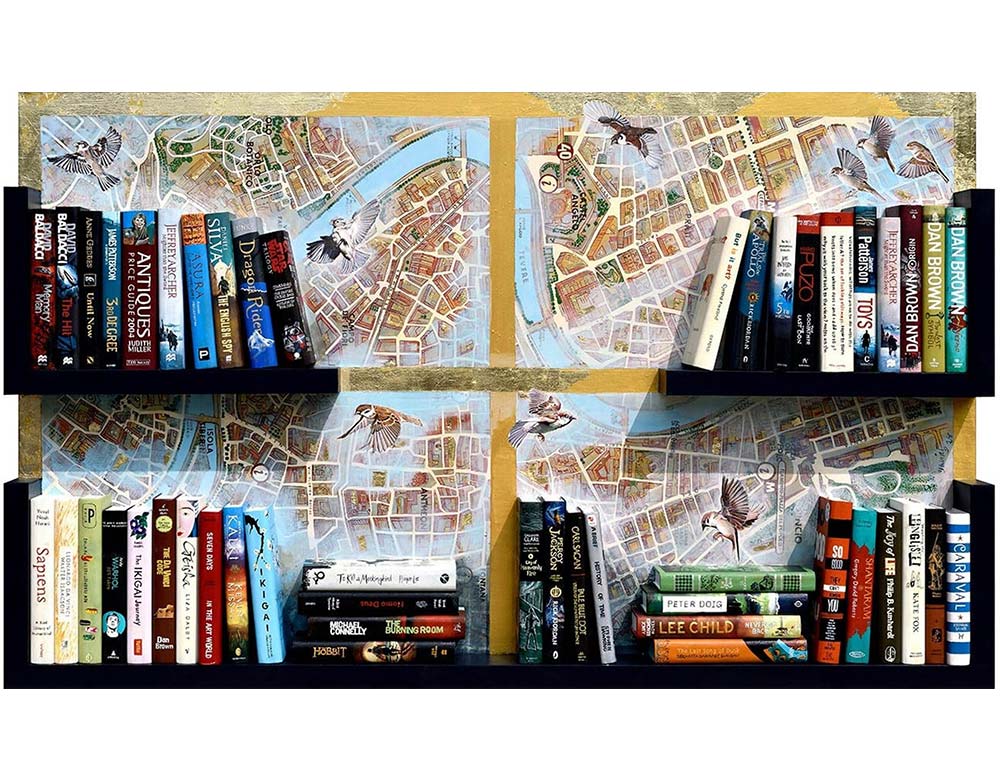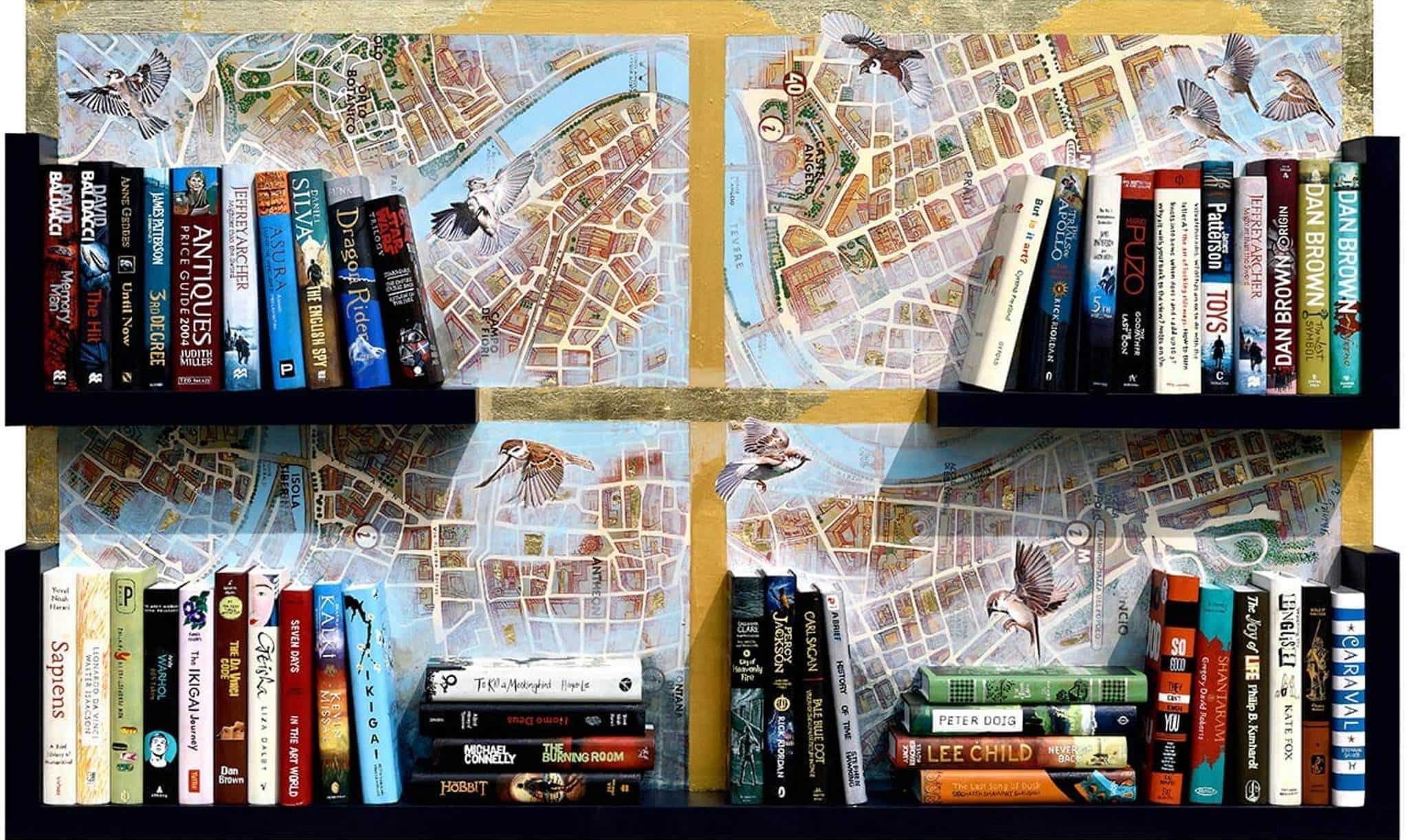
Arunanshu Chowdhury | Reactivating : The Golden Era | Acrylic & Mixed Media on Canvas & Wood | H 60 x W 37 x D 6 inches (Unframed & Delivered)
This artwork, titled “Reactivating: The Golden Era” by Arunanshu Chowdhury, is a striking blend of painting and installation that merges literature, urban mapping, and avian symbolism into one cohesive visual experience. Created using acrylic and mixed media on canvas and wood, the piece depicts a set of bookshelves filled with real or painted books, each spine meticulously detailed to evoke the tactile richness of a personal library. Behind the shelves lies a beautifully rendered map-like background, overlaid with delicate birds in flight, symbolizing freedom, knowledge, and exploration. The golden cross-structure running through the background adds a divine or timeless quality—perhaps alluding to enlightenment through art and literature. The juxtaposition of books and maps suggests the journey of the mind and spirit, where stories become pathways and reading transforms into a voyage. Chowdhury’s composition celebrates nostalgia and the enduring power of books in a digital age, reawakening the golden era of intellectual curiosity and creative adventure.

Arunanshu Chowdhury (b.1969, Hoogli, West Bengal). He studied art at the Faculty of Fine Arts, Maharaja Sayajirao University of Baroda, acquiring both his Bachelor’s and Master’s degrees in Fine Art there. Later moving from his native Bengal to Gujarat, much of Chowdhury’s body of work bears testimony to the changing role of the city.
Having spent most of his life in Baroda, Chowdhury’s art confronts urban violence in a manner which does not shock, but rather leaves a lingering feeling of vulnerability, almost haunting the viewer. Playing with the idea of historical memory, Chowdhury’s work can be called a reaction to acts of extreme violence. Highlighting the spectator-like role of the civilian, Chowdhury introduces the motif of the rickshaw – the most common mode of transport in Baroda, as a silent witness to urban atrocity. Other everyday objects, like the barber’s chair or a rocking chair play protagonists in his paintings, which teem with narratives but are unable to speak.

If you’d prefer the artwork to arrive ready to hang, please get in touch with us to arrange framing and shipping at applicable charges.
Please note: Customs duties and import taxes may apply at your destination in accordance with your country’s regulations. Refer to our International Shipment document for guidance and support.
| Medium | |
|---|---|
| Height | |
| Width | |
| Depth | |
| Surface | |
| Style |