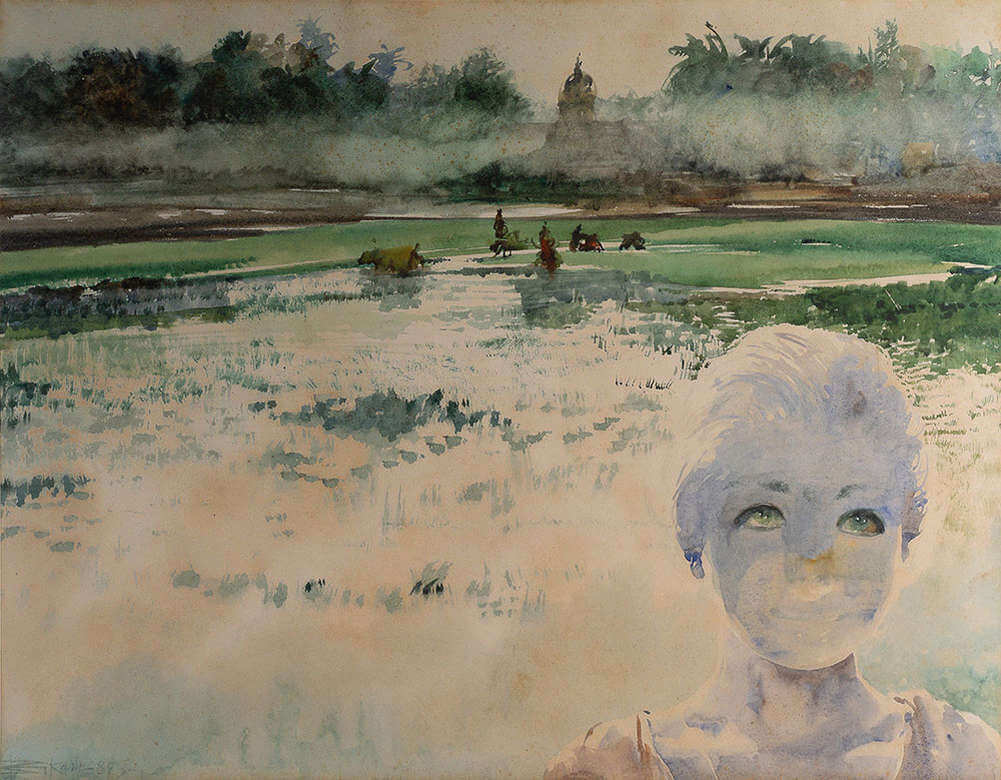
Bikash Bhattacharjee | Landscape | Watercolour on Paper | 18 x 23 inches | 1989
This delicate watercolour by Bikash Bhattacharjee, fondly remembered in Bengal as Bikash Babu, captures the quiet poetry of everyday life. A solitary figure gazes outward against a pastoral backdrop where temple and field merge into dreamlike memory.
The translucent washes and gentle tones evoke silence and introspection, offering a lyrical counterpoint to Bhattacharjee’s celebrated realist canvases. Rooted deeply in Bengal’s cultural landscape, the work reflects his enduring gift for transforming ordinary moments into timeless reflections.
Heading this exhibition, Landscape stands as a testament to Bhattacharjee’s legacy—an artist beloved for his humanity and revered among the great masters of modern Indian art.
This watercolour by Bikash Bhattacharjee is a rare and luminous example of his ability to transform the everyday into the poetic. At first glance, the pastoral landscape with its temple dome and quiet figures seems serene, yet the presence of the solitary figure with striking green eyes draws us into a deeper, more introspective space. The transparency of the medium allows Bhattacharjee to suggest memory and solitude with extraordinary delicacy, creating a work that feels both rooted in Bengal’s cultural landscape and suspended in timeless reverie.
While Bhattacharjee is celebrated for the dramatic realism of his Doll Series and his iconic portraits, this painting reveals another dimension of his genius — the ability to capture silence and atmosphere with equal intensity. It stands alongside his most important works not as a contrast, but as a complement, showing how his vision could move seamlessly between the psychological and the lyrical. In its quietude, this painting becomes emblematic of his legacy, reminding us that his art was not only about social critique but also about the inner life of Bengal itself.
Fondly remembered as Bikash Babu, Bhattacharjee remains beloved in Bengal for the honesty and humanity of his vision. His works continue to resonate with audiences who see in them both the beauty of their cultural heritage and the depth of their own emotions. In this watercolour, heading the exhibition, we find a work that sings softly yet powerfully — a testament to Bhattacharjee’s enduring place among the great masters of modern Indian art.
This evocative painting unfolds as a dreamlike landscape where memory, place, and human presence gently merge. A mist-laden riverside scene stretches across the composition, rendered in fluid washes of green, blue, and earthy tones that suggest early morning stillness. Small figures with cattle move quietly through shallow water, grounding the scene in rural life and timeless routine. Emerging softly from this atmospheric expanse is the translucent visage of a young child, her expression calm yet haunting, as if suspended between reality and recollection. The child’s face, delicately modeled and partially dissolved into the surrounding space, introduces a deeply emotional layer—suggesting nostalgia, loss, or the lingering imprint of innocence. The subtle interplay between figuration and landscape lends the work a poetic, introspective quality, inviting the viewer into a space where inner memory and outer world coexist.
 Born in a middle-class bengali family on 21 June 1940, Bikash Bhattacharjee gathered his visual and intellectual ideals from the politically charged atmosphere of calcutta during his growing up years.
Like many of his contemporaries, he was sympathetic to the principles and cultural values of the Communist Party. But his highly individualised perception of the world differed from the imagery representing either political leaders or suffering people. His characters were more than just representative of their class; they were imprinted as individuals, each with a well-etched subjectivity.
The end of the 1960s up to the mid-’70s was marked by a series of surreal paintings with a subtext of the demonic or subhuman in a setting of either dark fantasy or farce. The Doll series, conceived in 1971, was Bhattacharjee’s emotional response to the violence that erupted across Calcutta at the time as a result of the Naxal movement. Here, Bhattacharjee came close to the abstract mode by portraying humans as dolls with erased eyes, wiping out any individuality. The allegoric vision of the subverted feminine in his portraits of prostitutes, middle-class women, or women with extreme sexual appeal — rendered in photo-realist style — was another prominent theme in his work.
Bhattacharjee was honoured by the Academy of Fine Arts, Calcutta, in 1962, and received the Lalit Kala Akademi’s national award in 1971, the Bangla Ratna from the state government in 1987, and the Padma Shri from the Government of India in 1988. He passed away on 18 December 2006.

If you’d prefer the artwork to arrive ready to hang, please get in touch with us to arrange framing and shipping at applicable charges.
Please note: Customs duties and import taxes may apply at your destination in accordance with your country’s regulations. Refer to our International Shipment document for guidance and support.
| Medium | |
|---|---|
| Surface | |
| Height | |
| Width | |
| Style |