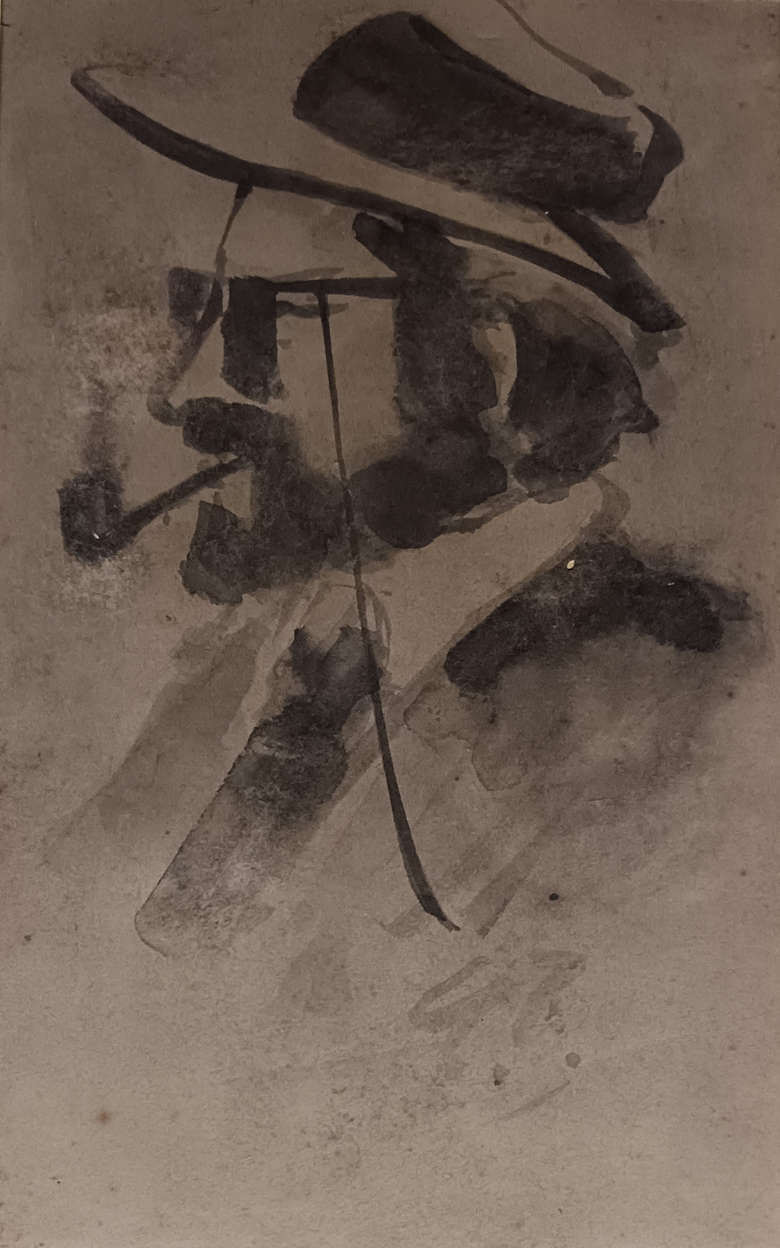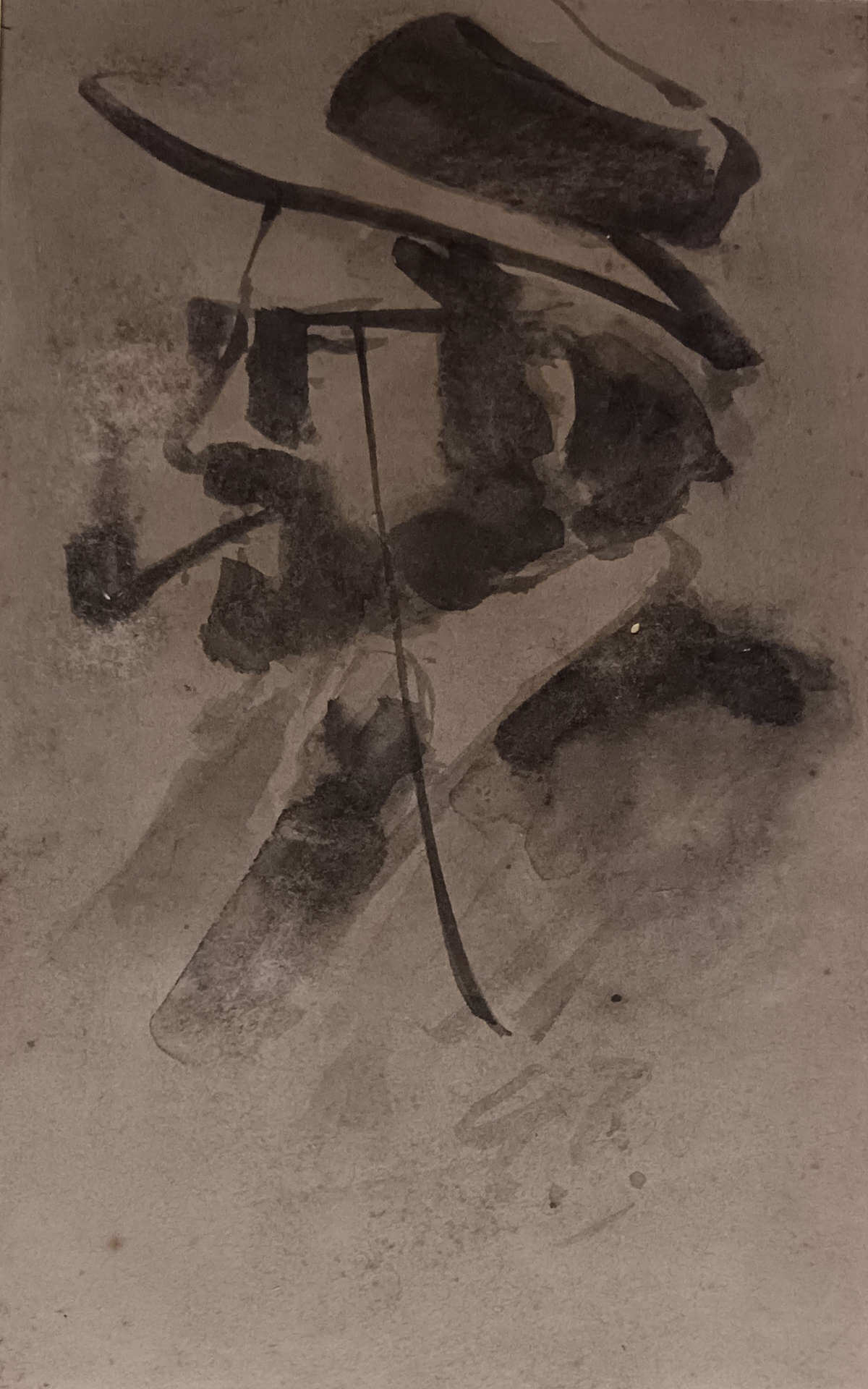
Gaganendra Nath Tagore | Untitled (Man with the Pipe) | Watercolour on Fine Board | 7 x 4.5 inches
This monochromatic ink portrait captures the silhouette of a gentleman through bold brush strokes and tonal washes rather than realistic detailing, creating a spontaneous, cinematic impression. The minimal composition emphasizes attitude over likeness, using a hat, spectacles, and pipe as defining motifs and showcasing Gaganendranath Tagore’s mastery in reducing form to its essential rhythm. The work reflects his modernist sensibility and his departure from the traditional Bengal School, marked by influences of Japanese ink wash, caricature, and early Western modernism. It embodies his sharp observation of urban society during colonial India and his move toward psychological expression and abstraction. More than a simple portrait, the painting stands as an important moment in the evolution of Indian modern art — where tradition gave way to innovation, spontaneity, and a new cultural language.
This subtle and evocative watercolor composition captures the essence of a figure through minimal yet expressive brushwork. Rendered in muted monochromatic tones, the image suggests the silhouette of a man with a pipe, formed through fluid washes and confident, calligraphic strokes. The loosely defined contours and layered transparencies allow the figure to emerge almost ghost-like from the surface, emphasizing mood and character over precise detail. The restrained palette and delicate handling of watercolor lend the work a quiet introspection, inviting viewers to pause and engage with its understated elegance. The painting reflects a modernist sensibility, where suggestion and abstraction work together to convey presence, movement, and inner life.
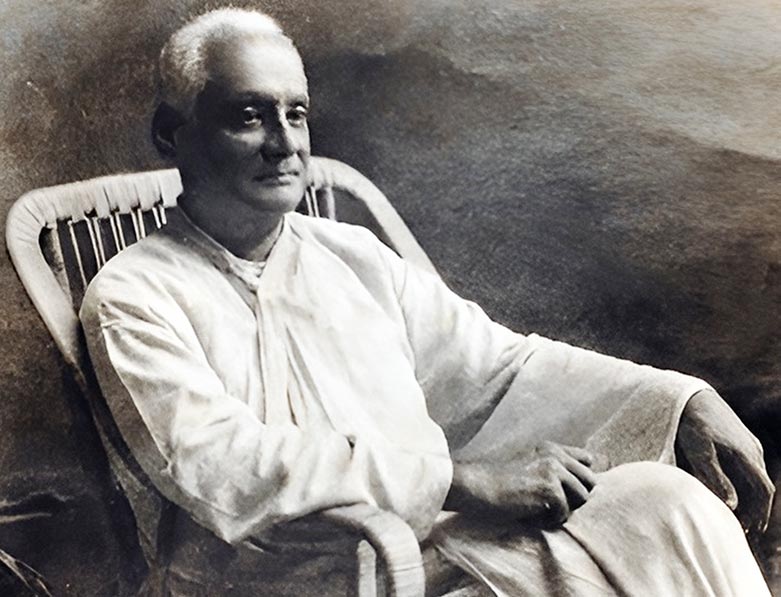 The true pioneer of cubism in India and acclaimed for his satirical works of art, Gaganendranath Tagore was born on 17 September 1867.
Gaganendranath Tagore (1867–1938), elder brother of Abanindranath and nephew of Rabindranath, was a pioneering modernist of the Bengal School. Though he began painting seriously in his late thirties, he quickly distinguished himself—first through Japanese-inspired brushwork and later with sharp caricatures that satirized colonial society. By the 1920s, he became the first Indian artist to fully embrace Cubism, creating bold geometric abstractions like City in the Night that fused Indian themes with international modernist vocabularies. As co-founder of the Indian Society of Oriental Art, he helped institutionalize modern art in Bengal. His legacy lies in bridging satire and abstraction, tradition and modernity, making him a crucial figure in the evolution of Indian modernism.
Along with his Nobel-laureate uncle Rabindranath Tagore, and brother Abanindranath Tagore, he was at the forefront of cultural revival in Bengal in the early twentieth century; the brothers established the Indian Society of Oriental Art, Calcutta, in 1907.
A self-taught artist, Tagore began painting late, at the age of thirty-eight. He learnt Japanese brushwork from visiting Japanese artists at Santiniketan. Initially, he painted Puri landscapes, portraits and other figurative sketches, scenes of Calcutta and illustrations for Rabindranath Tagore’s My Reminiscences, consisting of early known works Sibu Kirtania and Crows. In 1914, six of his paintings were sent to London, and then to the Pavilion Marson exhibition in Paris. Following this, cubism was introduced in his works. From 1917, he also published portfolios of cartoons, titled Birupa Bajra, Adbhut Lok, and Baba Hullod, which were merciless satires on contemporary Bengal society.
He was also the driving force behind the Vichitra club at the Tagore residence, even acquiring a lithographic press for it. He tried his hand—to enormous success—at each popular style of painting—watercolour landscapes, haunting night scenes, several Bengal School washes and Japanese brushwork.
His 1923 exhibition in Berlin and Hamburg received praise from German critics. He used form as a medium to communicate his feelings, and emphasised the structural quality in his works through semi-abstraction.
Tagore passed away on 14 February 1938.

If you’d prefer the artwork to arrive ready to hang, please get in touch with us to arrange framing and shipping at applicable charges.
Please note: Customs duties and import taxes may apply at your destination in accordance with your country’s regulations. Refer to our International Shipment document for guidance and support.
| Medium | |
|---|---|
| Surface | |
| Height | |
| Width | |
| Style |