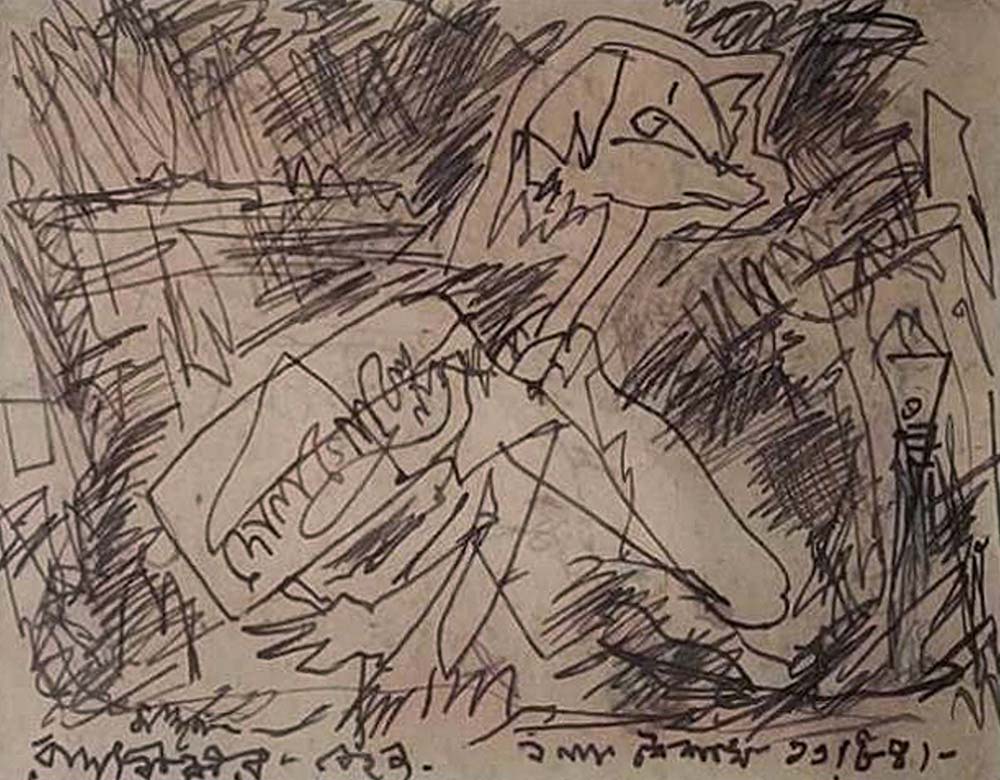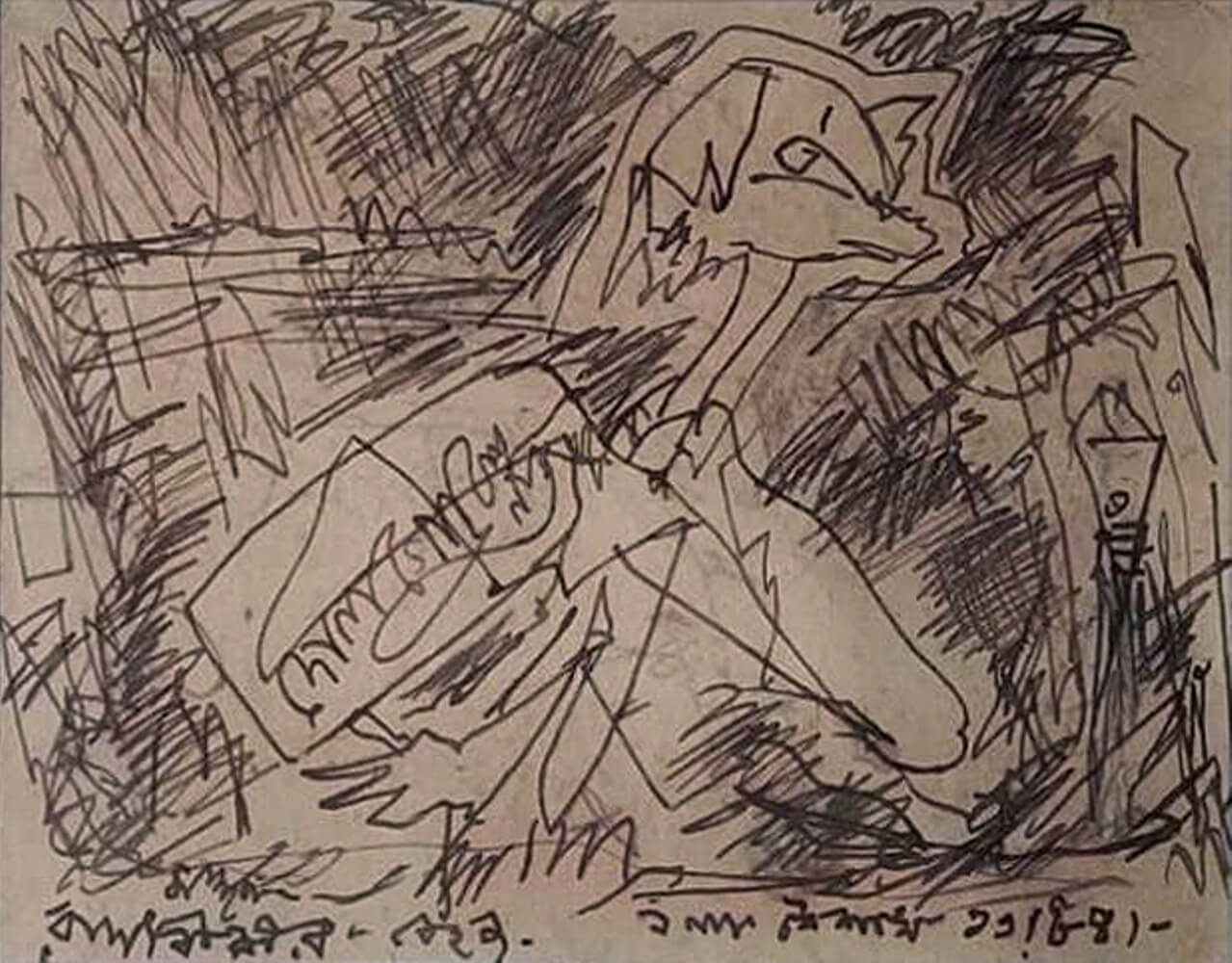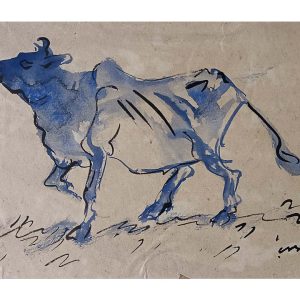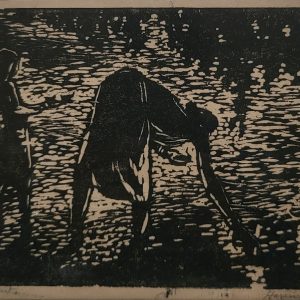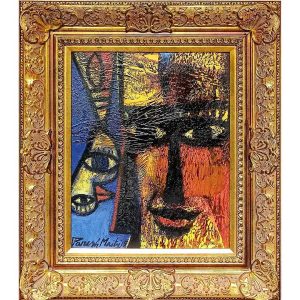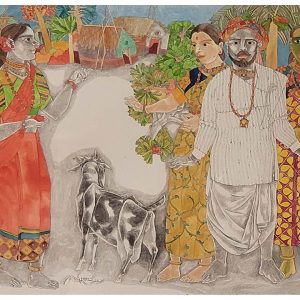
Ramkinkar Baij | Untitled | Watercolour & Ink Pen & Ink on Paper | 5 x 7.5 inches | Bengali Year 1384 | English Year 1977
This artwork is an untitled piece by Ramkinkar Baij (Watercolour & Ink on Paper, 5 x 7.5 inches, 1977 / Bengali Year 1384). It reflects the artist’s restless energy and raw spontaneity, qualities that defined much of his practice. The sketch, executed in swift and layered ink lines, captures a sense of movement, abstraction, and primal vitality.
At first glance, the composition may appear chaotic, but upon closer inspection, one can discern forms suggestive of animals and human figures, merging into one another within a charged environment. The sharp, angular lines and overlapping strokes highlight Baij’s tendency to let intuition and impulse guide his hand, resulting in works that are more experiential than representational.
Baij, one of the pioneers of modern Indian art and sculpture, often explored the intersections of man, nature, and society. Even in his drawings and sketches, there is a sculptural quality—a tension between volume and void, control and spontaneity. This work, created late in his career, embodies his uncompromising spirit and experimental approach, where the boundaries of figuration and abstraction dissolve into a powerful visual rhythm.
This untitled piece is not just a sketch but an expression of raw thought in motion, revealing the depth and complexity of Ramkinkar Baij’s artistic vision.

Born on 25 may 1906 in Bankura in Bengal, Ramkinkar Baij was an iconoclast who defied the artistic norms of santiniketan, where he had enrolled on the advice of journalist Ramananda Chatterjee.
One of the pioneers of modern Indian sculpture, Baij created art spontaneously, driven by intuition and energy and disregarding the artistic standards accepted by the institution.
A brief introduction to modelling by a visiting French sculptor led Baij to engage with clay in a unique manner and evolve a personal, innovative style that was largely untrained. He introduced cement concrete casting as an alternative to expensive plaster. The first artist in Santiniketan to use oil paint and create distinctly modern and abstract works, Baij painted on Santhal wraps with packet colours thinned with linseed oil and drew his figures on silk with a shoe brush as part of his innovations.

If you’d prefer the artwork to arrive ready to hang, please get in touch with us to arrange framing and shipping at applicable charges.
Please note: Customs duties and import taxes may apply at your destination in accordance with your country’s regulations. Refer to our International Shipment document for guidance and support.
| Medium | |
|---|---|
| Height | |
| Width | |
| Surface | |
| Style |